About the Astronomical Institute
With a history spanning more than 90 years, the Astronomical Institute at Tohoku University is a center for research and education in astronomy. Through theoretical research, observations, and instrumentation, we explore the Universe across a wide range of scales.

Our Philosophy
We are committed to fostering an environment in which highly motivated individuals can realize their potential and pursue research with autonomy and intellectual freedom.
History
Astronomy at Tohoku University began in 1934, when an academic chair in astronomy was established within the Department of Physics. It subsequently developed into the Astronomical Institute, comprising two academic chairs and providing both undergraduate and graduate education. Following the university-wide reorganization of 1994, the present structure was established: the Astronomy Course in the Faculty of Science at the undergraduate level, and the Department of Astronomy in the Graduate School of Science.
Today, our faculty members—whose number exceeds that of our students—cover a broad range of fields in astronomy and astrophysics. We provide comprehensive education and research supervision from the undergraduate through the graduate level, connecting foundational learning with cutting-edge research.
Education
At the undergraduate level, we place a strong emphasis on physics as the foundation of astronomy. Students first study fundamental physics alongside students in related physics programs before proceeding to specialized courses in astronomy and astrophysics. In addition to lectures, seminars, exercises, and practical training give students opportunities to work with observational and experimental data and to engage in theoretical reasoning. Through these activities, students develop the ability to uncover the physical principles underlying natural phenomena. In their fourth year, students work in small groups within individual laboratories on specific research topics, gaining practical experience in how research is conducted. Through this education, we aim to cultivate a broad perspective across the natural sciences, together with specialized knowledge and analytical skills grounded in flexible and creative thinking.
At the graduate level, we aim to educate researchers in astronomy and astrophysics, as well as highly skilled professionals who can apply the knowledge and techniques acquired through astronomy to a wide range of fields. With a balanced faculty and diverse research approaches spanning theory, observation, and instrumentation, we provide an educational and research environment that accommodates a broad range of student interests. In the master’s program, students systematically progress from the foundations of astronomy to specialized research methods, primarily through lectures and seminars. By presenting their research and participating in scientific discussions, students learn how to develop and evaluate scientific arguments, communicate their findings, and advance their research.
Research
We conduct research across a wide range of scales in the Universe through theory, observation, and instrumentation. Our theoretical research addresses topics including the large-scale structure of the Universe; the formation and evolution of galaxies and galaxy clusters; the formation of stars and planetary systems; stellar structure and evolution; transient and high-energy astrophysical phenomena; and physics under extreme conditions. Our approaches range from analytical methods to large-scale numerical simulations. Our observational research uses some of the world’s most advanced ground- and space-based telescopes and facilities operated by institutions such as the National Astronomical Observatory of Japan and the Institute of Space and Astronautical Science. By acquiring and analyzing observational data, we seek to understand the diverse physical phenomena occurring throughout the Universe. Our research encompasses extra-solar planetary systems, stars, the interstellar medium, galaxies, active galactic nuclei, galaxy clusters, and cosmology. We are also actively engaged in the development of astronomical instruments. By creating new observing techniques and instruments, we open new windows on previously inaccessible aspects of the Universe and contribute to the advancement of astronomy worldwide.
Milestones in Our History
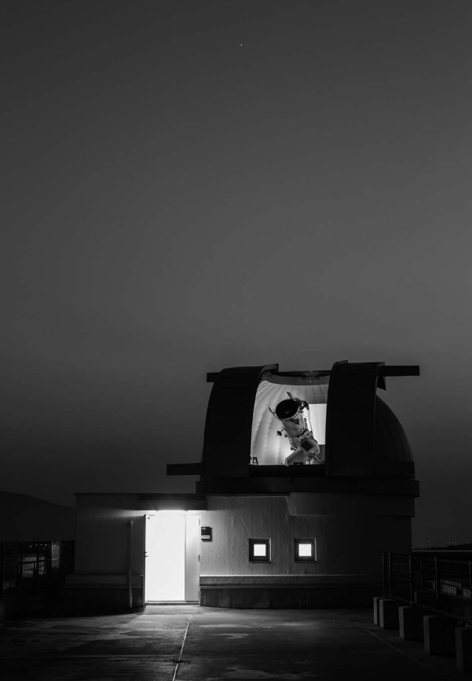
The telescope dome formerly located on the roof of the Physics Building, before the Astronomical Institute relocated to Science Complex C.