
Mapping gas motions in planet-forming disks
The exoALMA Large Program maps gas motions in protoplanetary disks at high precision. By visualizing small deviations from Keplerian rotation, we search for signatures of embedded planets and other physical processes that shape the evolution of planet-forming environments.
Probing the origins of planetary systems from their birth environments
Understanding what determines the properties of planetary systems requires investigating the sites where planets are actively forming. Around young stars, disk structures composed of gas and solid particles (dust) naturally form during the star formation process. While part of this material accretes onto the central star, planets are thought to form from the remaining material. Such circumstellar disks are known as protoplanetary disks.
Recent high angular resolution observations have revealed that protoplanetary disks host a variety of substructures, including rings, gaps, spiral patterns, and localized concentrations of dust. These features may represent signatures of planet formation or evidence of interactions between forming planets and their surrounding disks. Using ground- and space-based facilities, including the Subaru Telescope and ALMA, we characterize disk structures and the properties of exoplanets, emphasizing a unified view that links planet-forming environments to the mature systems. We explore how disk evolution leads to the diverse architectures of planetary systems through observational insights.

Dust continuum emission from a protoplanetary disk that reveals asymmetric structures.(Credit: A. Nishida)
Constraining the mechanisms of planetary system formation
Rings, gaps, asymmetries, and complex gas kinematics in protoplanetary disks provide important clues to the processes driving disk evolution. Forming planets can perturb the surrounding gas, creating gaps, vortices, and localized gas motions, while magnetic fields, turbulence, disk winds, and pressure structures can also shape disk evolution and mass transport independently of planets.
We interpret disk structures and gas kinematics by linking observations with theoretical models and numerical simulations. By placing these signatures in the context of global disk dynamics, we aim to uncover the underlying mechanisms. In particular, in close collaboration with theorists, we investigate how gas dynamics, magnetic fields, and pressure structures regulate dust concentration and growth, thereby shaping planet-forming environments.
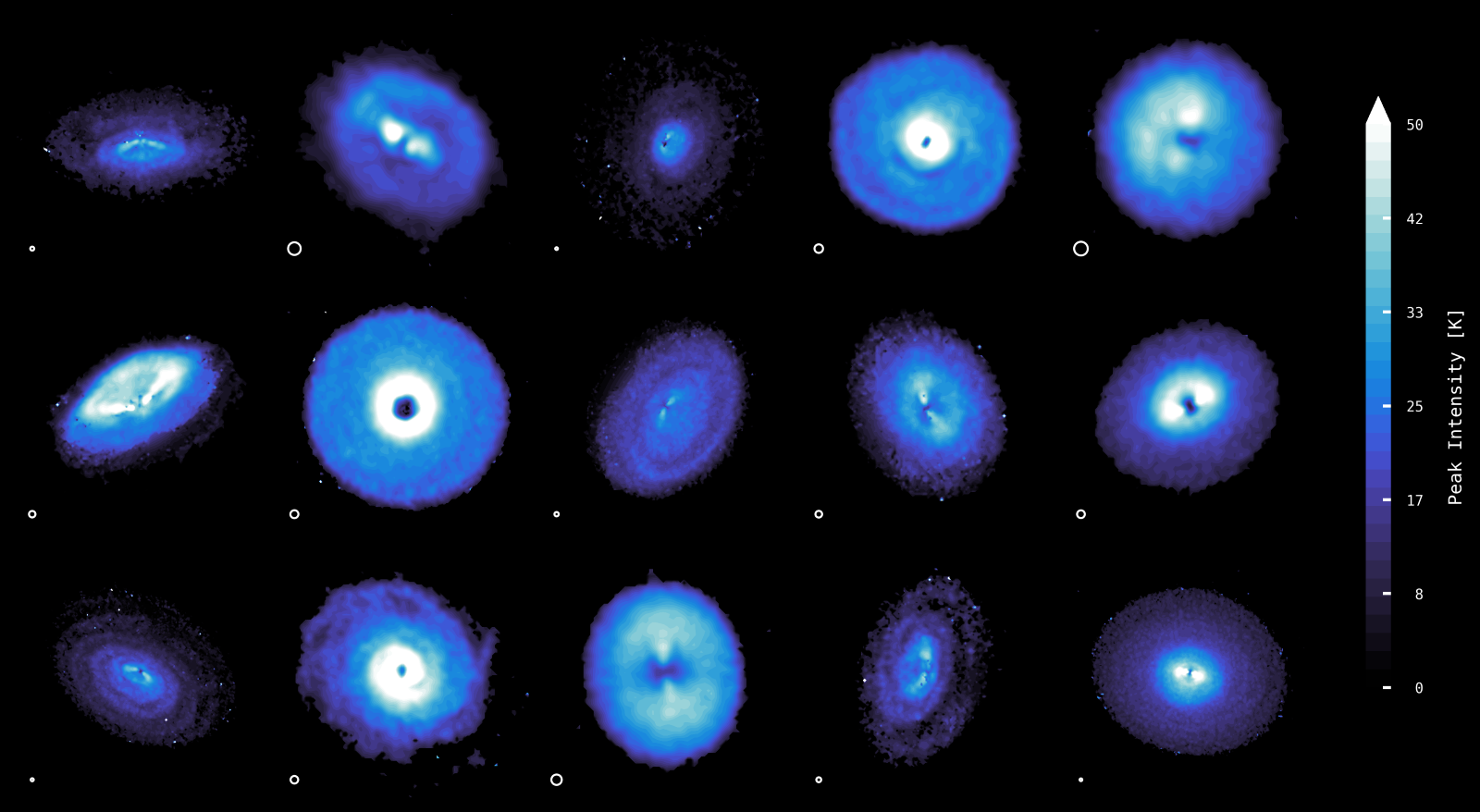
CO peak-intensity maps from exoALMA reveal the spatial distribution of gas in planet-forming disks,providing a basis for studying disk dynamics
Tracing the Evolution of Planetary Materials
Understanding what kinds of planets emerge therefore requires not only studying disk structures and dynamics, but also the properties of the disk material itself. Disk temperature, density, ionization, UV irradiation, gas dynamics, and dust settling and growth interact with one another, jointly shaping the spatial distribution and chemical composition of gas and dust. It is thus essential to treat the physical state of disks and the evolution of their material together.
For example, as dust grows and settles toward the disk midplane, the radiation field reaching the disk surface and the thermal structure of the gas are altered, affecting chemical reactions and molecular distributions. The composition and ionization state of the gas are also closely linked to disk dynamics, interactions with magnetic fields, and gas dispersal processes. In this way, disk dynamics, transport processes, dust growth, and the chemical evolution of gas and solids are inherently interconnected.
Through molecular line and dust continuum observations, we aim to reveal how planetary building blocks evolve within disks and ultimately give rise to the planetary properties. Bridging physics and chemistry, as well as structure and composition, we seek a comprehensive understanding of planet-forming environments.

Dust continuum and molecular-line observations trace different components of planetary building blocks. (Credit: NAOJ)